
Lords of Shit
Are we rebuilding feudalism through enshittification?
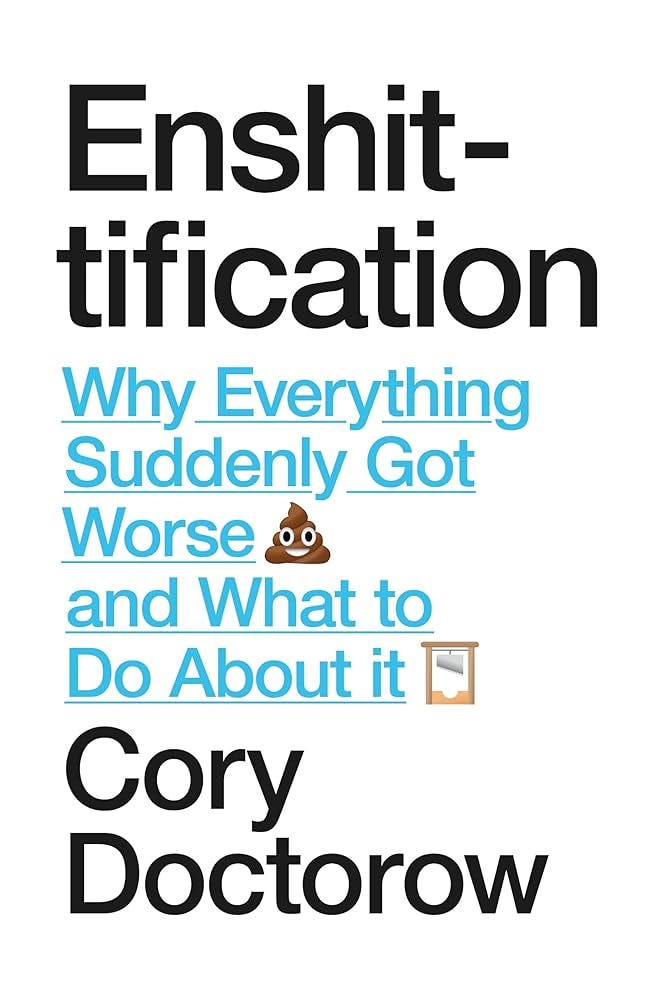
I wrote about Cory Doctorow’s book, Enshittification, a few months ago after listening to a podcast interview. On reading the book, Doctorow’s central premise is undeniable and inextricable: our digital lives have turned to shit. Social media sucks—I’m pretty sure this is universally accepted—but in turn this makes our politics and everyday conversations suck too.
I recently saw a busload of kids heading to high school. Every single one of them, bar none, wore headphones, and most of them craned their necks to stare down at their own private screens. Am I saying that the old-fashioned, unplugged experience of riding a bus to school is somehow sacred and wonderful? Of course not. But we really did not appreciate the social power and creative necessity of boredom—or the threat of boredom—did we? And now we’ve built a brave new world to counter and shrivel and kill that boredom at every turn. Was it worth it?
Just as with buying stuff online, ride-share services or meal-delivery apps, the promise of instant, friction-free, global connectedness and information sharing was exciting at first. But these experiences have turned to shit—they’ve become “enshittified”. Doctorow charts in his book how these outcomes are not inevitable. They aren’t structurally guaranteed or baked into the long march of social economics. Rather, they are the product of policy decisions over time—and these decisions can be overturned.
Unfortunately, the ones pushing for these outcomes are outrageously powerful corporations that have convinced us that their emerging monopolies are good, legally proper, and should be protected. And their vision for a new world order has historical precedent. Yanis Varoufakis calls it “technofeudalism” in his book because it is a system that, much like feudal society in medieval Europe, prioritizes “rent extraction” over profit.
The fundamental building block of a feudal society is land ownership. If you own the land, you can charge rent to those who wish to live and work on it. Your only real obligation is to defend the land, and thus the status quo which grants it to you. You are the aristocracy, and when things are really humming, you can devote your entire life to leisure. Or fighting, that works too. Naturally, a “protection racket” emerges in parallel: you pay me, your landlord, and I’ll protect you. If you don’t pay me, well, “it would be a shame if something happened to that nice family of yours...”
Capitalism prioritizes profit over rent. Feudalism started to wane in western Europe as the forces of profit-making (merchants, craftsmen, manufactories, and eventually businesses) became ascendant. Rents were still paid and property was still owned, but you could make a quicker and bigger buck by gathering a bunch of workers together to produce something you could then sell for more than it cost to make.
Hey! Enjoying this? Share it with someone you think would dig it too, and nudge them to subscribe. I don’t use social media anymore, so I’m relying on old-fashioned shares and word-of-mouth. Like and comment—I’d love to hear what you think!
Money plus workers equals more money. In economic terms: capital plus labour equals profit. This movement was turbocharged in the Industrial Revolution, and led to the world as we know it today.
At first this might sound like six of one and half a dozen of the other. What’s the functional difference between a landlord and a business magnate? Aren’t they both just the rich preying on the poor—a reshuffling of the same old aristocracy? The key difference is competition. If someone starts making enormous profits by making and selling sweaters, you too can make and sell sweaters, and at a lower price. People will buy your sweaters, until the other guy lowers his price. And so forth, until prices are low and you are forced to differentiate yourself by selling sweaters with pictures of wiener dogs on them.
That’s a very simplistic summary1, but I hope you’re still with me. Because technofeudalism is what might come next: a return to the past, where rents are prioritized over profits. Who doesn’t want to just own something that produces revenue on which you can live, instead of work or manage a business? Unfortunately, it’s not just real estate entrepreneurs who think this way: it’s also Google, Amazon, Apple, Microsoft, Uber, DoorDash, and Facebook.
You might think that it’s a pain in the ass to have multiple social media platforms, and maybe even have to send those photos of your wiener dog to me directly (oh the horror!). You’d rather just force me and everyone else to be on the absolute pile of garbage that is Facebook. Maybe you’re right. Doctorow (much like Jonathan Haidt says about smartphones for kids) calls this a “collective action problem”.
However, the result is a monopoly that doesn’t need to compete to make a profit, but can instead extract rent from its legally-protected domain. According to Doctorow, Amazon takes up to 51 cents from every dollar sent to sellers on its platform, simply by being the default marketplace. Imagine setting up a tent at the farmers’ market, and having to pay more than half of everything you make to the organizer? You would never agree to that. Unless the farmers’ market was the only convenient and reasonable place people go to buy their groceries.
Technofeudalism and enshittification go hand-in-hand, but that’s only part of why this is bad. Feudalism isn’t merely defined by economic jargon like rent vs. profit. It’s a system predicated on profound inequality. That’s inequality of ownership and money, sure, but also of education, opportunity, mobility, and legal rights. I’m not arguing that modern capitalism is some egalitarian paradise. But with feudalism, the inequalities are baked-in. They are intractable, enforceable, and usually inescapable. The premise of technofeudalism is the same, even if it looks or feels differently.
A technofeudal serf might still have an iPhone and a gym membership and a giant TV at home, but they will be forced to pay their rent. And that rent will take the form of two dozen digital subscriptions, a daily truckload of personal data being mined, their constant attention to tailored marketing, and their resignation to the fact that pretty much everything they buy is a pile of shit anyways2. Perhaps worse is their complicity in a new social contract in which all of the consumer wonders of the modern world are available if you agree not to fight it. Much like the modern social contract in today’s China: we’ll deliver rapid economic growth and growing wealth, and in exchange you can’t question the State or complain when we quash your rights.
Feudalism in Europe was eclipsed not just by a new economic system, which was accelerated by technology and global trade, but by the Renaissance and the Enlightenment. We continue to live in an era where an immense amount of knowledge is shared and available and, at least ostensibly, everyone can follow their curiosities and open their minds. It is this sheer magnitude of learning and openness in how it is shared that has made generative AI possible.
However AI fits into the story, it follows that technofeudalism will require not just technology and global connectedness, but a dark age of thought. Perhaps even a closing of our minds. I think that’s a good reason to fight enshittification. That, and… you know, maybe to stop everything turning to shit.
How? Doctorow thinks it’s about government policy: from robust antitrust enforcement to the right to self-repair. But I think a level of consciousness can do its part too: for us to simply choose, when possible, to buy local and in-person. To seek out and select products and services that are not (yet) shit. To refuse the new paradigm, and cling to the fading memory of that halcyon past where a fridge could last more than five years. To stop bitching and complaining about how terrible social media and smartphones are, and actually do something for ourselves. Get off Facebook.
Maybe this is as dumb as tackling climate change by turning off a TV when we’re not in the room. But it should be off, damn it. We can at least start there.
Did you enjoy this piece? What do you want to see more, or less of, in the future? Let me know!
Quote of the Week
“Enshittification didn’t happen because today’s companies are run by evil geniuses. They’re no more wicked than the mediocrities who founded DEC or Sun or AOL. All of those companies would have abolished their competitors, captured their regulators, and abused their users and business customers if they could have gotten away with it. We didn’t let them get away with it, but we let the current crop get away with murder.”
— Cory Doctorow
Historians also emphasise the role of the Black Death, peasant revolts, enclosure, and the breakdown of serfdom as labour relations shifted.
Black Mirror explored this in “Common People”, which I wrote about
It’s way too easy today. But wait a little more years. Easy will create incredible difficulties for the new generations to come. The lords of shit won’t go away. Easy will be difficult.